
The Power of Blueberries

The Power of Blueberries

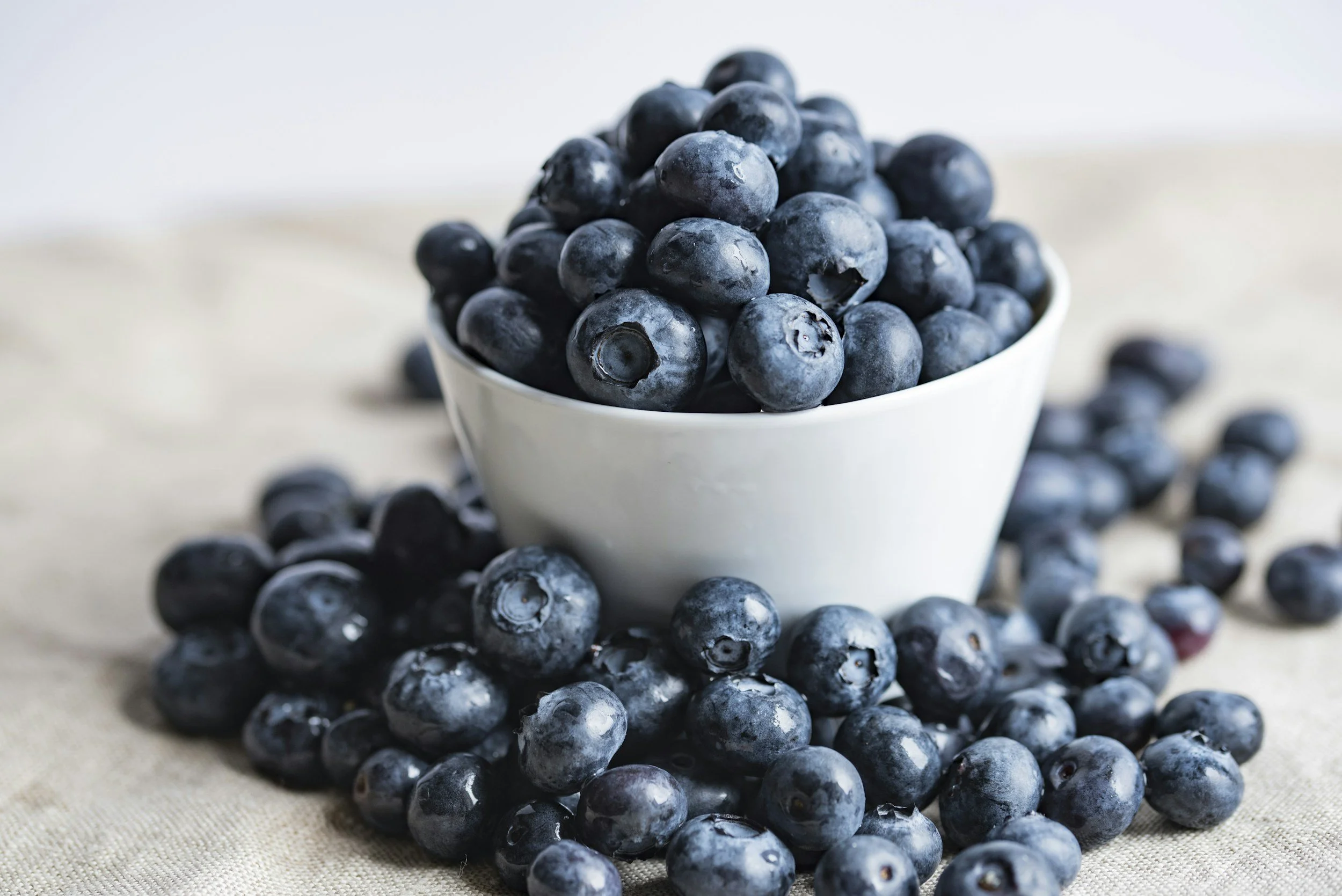
Blueberries are brain food, according to The 150 Healthiest Foods on Earth by Jonny Bowden, Ph.D., C.N.S. Dr. James Joseph, one of the leading scientists studying blueberries and brain health, found that when middle-aged rats are given blueberries, their motor and memory functions improve and mental deterioration—as well as loss of coordination and balance—is prevented. Compounds like anthocyanins, which are antioxidants and anti-inflammatory agents, are responsible for this. Inflammation and oxidative stress are involved in virtually every major disease: Alzheimer’s, Parkinson’s, diabetes, heart disease, and even aging and arthritis.

Blueberries also help neurons in the brain communicate more effectively, keeping your memory sharp. Polyphenols turn on signals and enable the brain to grow new connections. What’s more, they may help lower blood cholesterol and promote urinary health. They have even been shown to improve vision. Antioxidant and anti-inflammatory compounds in blueberries also help fight cardiovascular disease. Blueberries have one of the highest ORAC values (oxygen radical absorbance capacity), a rating system for antioxidant power. They have also been shown to contain pterostilbene, which can lower lipid levels—sometimes more effectively than some medications. Wild blueberries showed the greatest anti-cancer activity.

Make blueberries part of your daily routine. You only need 1/2 cup per day to see the benefits. Throw them in a smoothie, on a salad, or eat them with yogurt.

Comment below with how you like to use blueberries.

VALUE BASED CARE

Comment

VALUE BASED CARE

Who's Getting Paid to Keep You Sick?

On the battle between profit and patients — and the model that could change everything

Two Models. One Big Fight.

Somewhere in a boardroom right now, a private equity firm is deciding how many ER visits is enough. They bought the emergency room. They pay the doctors. And they get paid every time you walk through that door.

That's Fee-for-Service (FFS) in a nutshell: the more you need, the more they earn. It's not conspiracy — it's just math. And the math is working against you.

The alternative? Value-Based Care (VBC) — a model where providers are compensated based on your outcomes, not the volume of services you consume. The idea is elegant: align the financial incentive with your health. Hospitals get paid to keep you healthy, not to keep you coming back.

"Hospitals being paid to keep you healthy may sound radical. That's because it is — and it shouldn't be."

We're Moving. But Barely.

According to the U.S. Department of Health and Human Services, the share of healthcare payments tied to value-based care reached 34% in 2017, up from 23% just two years prior. That's real momentum — but let's be honest about what the other number means.

66% of payments are still tied to volume. Two-thirds of the system still rewards quantity over quality, procedures over prevention, intervention over outcomes. One step forward, two steps back.

The Finance Bros Showed Up.

Private equity has been quietly buying up emergency rooms, physician groups, and urgent care chains across the country. Their job isn't medicine — it's returns. And returns come from billing, not from your blood pressure staying low.

As Marc Harrison outlined in his 2019 Harvard Business Review piece, A 5-Point Framework for Value-Based Health Care, the path forward requires fundamentally realigning incentives with outcomes. But when the entity controlling the doctors is an investment fund with a 5-year exit strategy, those incentives get complicated very fast.

The doctors aren't always the villains here — they're often caught between their instincts and their employers' spreadsheets. The system is the problem.

Utah Already Proved It Works.

At Intermountain Healthcare, they didn't wait for politicians to figure it out. They built a team-based care model focused on 31,000 patients with one guiding principle: prevention over intervention. The results?

  • 60% decrease in hospital admissions

  • 35% decrease in ER visits

  • 20% decrease in monthly costs

  • And — most importantly — the patients are healthier

This isn't theoretical. It's not a promising pilot program from a research lab. It happened. The model works. The question is why we aren't scaling it — and the answer, unfortunately, keeps coming back to money.

The Unsexy Work Nobody Wants to Fund

Big Pharma breakthroughs are exciting. Surgical innovations make headlines. But food insecurity, housing instability, and social isolation — the so-called social determinants of health — are quietly driving outcomes in ways that no drug or procedure can fully fix downstream.

This is the "unsexy" work. There's no billing code for helping someone find stable housing. No investor deck gets funded around combating loneliness in elderly patients. Yet these factors are among the strongest predictors of who ends up in the ER, who manages their chronic illness, and who simply doesn't make it.

We've built a system that subsidizes the dramatic over the preventive. Every year we don't fix it, we're choosing profit over people — whether we mean to or not.

Prevention is boring. It's also the only thing that actually works at scale.

So Where Do We Go From Here?

Value-Based Care isn't radical. It's rational. It's proven. The data supports it. Intermountain Healthcare demonstrated it. The question isn't whether it works — it's whether the people writing the checks, lobbying the legislators, and buying up the ERs will allow it to scale.

Focusing on prevention lowers costs, improves lives, and reduces pressure on an already strained system. The model exists. The evidence is there. What's lagging is the political and financial will to let it win.

Until that changes, we'll keep doing this: one step forward, two steps back — while the billing department cashes in.

Inspired by Marc Harrison's "A 5-Point Framework for Value-Based Health Care" — Harvard Business Review, October 2019.

Comment

HAPPINESS AND QUALITY OF LIFE VS. GDP

Comment

HAPPINESS AND QUALITY OF LIFE VS. GDP

Does More Money = Better Health? 🤔💰

Quick question before we dive in: If I told you Country A spends $12,000 per person on healthcare while Country B spends $6,000, which country do you think has healthier, happier citizens living longer lives?

If you picked Country A... WRONG! (Don't worry, America's entire policy apparatus got this wrong too.)

Here's the plot twist that made my MBA brain short-circuit: The United States spends more on healthcare per person than literally any other developed nation—over $12,000 annually, roughly double what most comparable countries spend. We have the world's highest GDP. By every metric business schools worship, we should be crushing it in the health department, right? Instead, we're getting schooled by Slovenia in life expectancy. Trailing Chile in healthy life years. Edged out by Costa Rica in overall wellbeing—a country spending a fraction of our healthcare budget. It's like spending twice as much on a gym membership and ending up less fit than your friend who does free YouTube workouts. The math isn't mathing.

Here's why: We're measuring economic activity (how many dollars change hands) instead of actual outcomes (are people healthy and happy?). GDP counts a billion dollars spent on chemotherapy the same as a billion spent on preventing disease in the first place. Both boost the economy identically, but one keeps you healthy while the other manages your decline. Meanwhile, other countries figured out decades ago that maybe—just maybe—we should measure things that actually matter. Like health-adjusted life expectancy (not just how long you survive, but how many of those years you're actually healthy). Or disability-adjusted life years (because living to 85 while bedridden for the last 15 isn't the same as living actively to 80). Or—wild concept—actual happiness metrics that ask people if their lives are, you know, good.

Your Turn! 👇

I want to know: If you could redesign how we measure a country's success, what would you include in the formula?

Vote by commenting below:

🏥 A) Healthcare outcomes (not spending, but actual health)
😊 B) Happiness & life satisfaction
💼 C) Work-life balance
🏡 D) Housing affordability
🌍 E) Environmental quality
🤝 F) Community & social support
💰 G) All of the above because why are we choosing?!

Bonus challenge: Tell me one thing your country does well that doesn't show up in GDP numbers but absolutely improves quality of life. (I'll start: NYC's free parks are health interventions disguised as green space, and GDP doesn't capture that value at all.)

Let's crowdsource a better scorecard in the comments! 👇✨

P.S. If you're curious about the actual data behind this (spoiler: it's even more damning), drop a 👀 emoji and I'll share the full country comparison charts. Prepare to be shocked by who's beating us and what they're doing differently.

Comment

AMERICAN HEALTH INSURANCE SCHEME

Comment

AMERICAN HEALTH INSURANCE SCHEME

We know that health insurance in America is hard to come by without paying a pretty penny, so most of us get our insurance paid for by our employer, but how did this come to be? Private health insurance began in the 1930s as a Great Depression lifeline, then really took off after World War II when employers—facing wage freezes—started offering benefits to attract workers. At the time? It seemed brilliant. A safety net. The beginning of something good… Plot twist: It became something very different.

The Numbers Tell a Story

The Price Evolution:

  • 1930s: Health insurance cost about $12 per year

  • 2025: Employer-based insurance costs $27,000 per year

  • That's 240 times more expensive (not 240% more—240 times more)

  • Last year alone, premiums jumped 6% while wages stayed basically flat

Who's Left Out:

  • 27-30 million Americans remain uninsured (US Census Bureau)

  • Without employer coverage, individual insurance is often financially out of reach

  • One job change or layoff can completely upend your healthcare access

The Good News (Yes, There's Some!):

  • The Affordable Care Act cut uninsured rates nearly in half—from 16% to 8-9%

  • Millions gained coverage who couldn't get it before

  • Pre-existing conditions can no longer be used to deny coverage

The Catch:

  • Even with insurance, deductibles and out-of-pocket costs can be overwhelming

  • You pay premiums monthly, then often pay significant amounts when you actually need care

  • The ACA remains politically vulnerable despite helping millions

Medicaid Matters:

  • Covers low-income Americans with little to no cost—a genuine lifeline

  • New York's 2025-2026 Medicaid budget: $109.6 billion (up $7.7B from prior year)

  • The system works for millions, but it's constantly under budget pressure

The Prevention Opportunity We're Missing

Here's where it gets interesting: Instead of investing in keeping people healthy, we're focused on managing illness after it happens.

Why? Prevention requires thinking 10-20 years ahead. Political cycles run 2-4 years. The math doesn't work.

But Some Places Get It:

  • New York spends $110 more per person on prevention than the national average

  • Result? Fewer expensive emergency interventions down the line

  • Yes, taxes are higher—but the investment pays off in healthier communities

The Big Picture

  • National debt: $37 trillion

  • Healthcare's share: ~20% of the entire US economy

  • What we could do differently: Shift even a fraction of that spending toward prevention, food access, and early intervention

We're not doomed—we're at a crossroads. And that's actually exciting, because crossroads mean choices.

Let's Get Real: Your Turn

Here's what I'm curious about:

If you could redesign one thing about health insurance in America, what would it be? More emphasis on prevention? Price transparency? Universal coverage? Something else entirely?

I want to hear your ideas—especially if you've found creative ways to navigate the current system or if you live somewhere doing it better.

Drop your thoughts below. 👇

P.S. Some states and cities are experimenting with innovative approaches to healthcare access and prevention. The future isn't written yet—and that means we still get to shape it. What role will you play?

Comment

East Meets West

Comment

East Meets West

It’s time to heal America. Prevention through proper nutrition and channeling universal energy is the answer to our healthcare quandary. Ancient Eastern Medicine teaches us how turmeric, lemon, ginger, and raw honey boosts the immune system, or how the gut functions as the second brain, with intricate hormonal pathways centered around a thriving microbiome. Eastern practices have paved the way towards holistic health and is finally accepted by the West with functional medicine at its core, looking at the whole person, not just using prescription medications.

Long before we had modern technologies, such as sophisticated MRI machines and blood testing capabilities, ancient healers were mapping the invisible—tracing energy through meridians and balancing yin and yang like master musicians tuning an instrument. Acupuncture, for example, was founded in China approximately 3,000 years ago, with the first documentation in the Yellow Emperor’s Classic of Internal Medicine, dating back to 100 BCE. It was then outlawed in China in 1822 and again in 1929, dismissed as superstition by those turning towards modern medicine. Like America, where Eastern practices only recently gained respect, acupuncture is now covered through insurance. Health isn’t something you buy; it’s something you cultivate, one meal, one breath, one conscious practice at a time.

Comment

Nutrition Basics

Nutrition Basics

Understanding nutrition doesn’t have to be complicated. When words like carbs, protein, fats, and macros are thrown around, it’s easy to feel confused. This beginner’s guide explains nutrition basics in a simple, realistic way, helping you learn how balanced meals support everyday energy, wellness, and sustainable health goals.

The Diet

The Diet

Diets are often associated with restriction and frustration. This guide introduces the Mediterranean diet as a flexible, nourishing way of eating that focuses on balance, enjoyment, and long-term health rather than perfection or strict rules.

Gut Health

Gut Health

Gut health plays a vital role in overall wellness, yet it’s often overlooked. Your gut impacts digestion, energy levels, immune function, mood, and even mental clarity. This post explores simple, realistic ways to support gut health through nourishing foods, balanced routines, and sustainable habits that work with your body—not against it.

Valentine Reed-Johnson